
Sustainability at the University: an integrated vision
Sustainability permeates every aspect of University life and society, such as resource management, social responsibility, people's well-being, quality education, and impact on the region. The University of Bologna promotes a development model that is first and foremost human, combining innovation, fairness, respect and inclusion, and translates it into strategies and actions that actively involve the entire community.
Sustainability Report: transparency and impact
The 2026 Sustainability Report outlines the impacts of the University of Bologna during 2025, building on a process that began more than a decade ago with the University’s first Social Responsibility Report.
Over time, the report has taken on a broader role. Rather than simply recording the University’s activities and achievements, it helps to show how its decisions affect the university community, local communities, the environment and the use of public resources.
The Report presents data, projects and indicators relating to the main dimensions of university life: the quality of education, the right to higher education, research, people’s work, environmental sustainability, relationships with local communities, and the economic and social impact of the Multicampus system.
This commitment is widely recognised in the international rankings in which the University of Bologna stands out. Find out more in the dedicated section.
The University of Bologna participates in international strategic networks such as RUS (Rete delle Università per lo Sviluppo Sostenibile - Network of universities for sustainable development), ASViS and SDSN.
The 2026 Sustainability Report
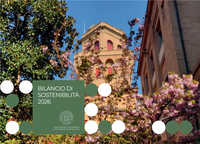 View the documents:
Taking stock: achievements and prospects
The 2026 Sustainability Report:
- introduces for the first time an analysis of the economic impact generated by the presence of students in the local area. Through a survey, the direct contribution to the economic life of the Multicampus cities is estimated at over €808 million in total, between Bologna and the Romagna campuses;
- devotes an in-depth section to reporting on projects financed by the NRRP and the Complementary National Plan offering a transparent account of the use of funding and the effects produced for the University and for the research network;
- highlights the role of professional staff as a strategic lever for the future of the organisation with data on newly hired staff, attracting and retaining young talent, continuing education, welfare and organisational wellbeing.
Share your opinion on the 2026 Sustainability Report:
complete the questionnaire (in Italian)
3,077 MWp
Photovoltaic capacity installed in 2025
almost doubled compared to the previous year.
€127.6 million
Measures in support of students
including scholarships, international mobility and other support measures.
31,5%
Women among teaching staff
this figure highlights a gap that is still present in senior roles.
86%
Professional staff involved in learning activities beyond mandatory ones
up compared to 81% in 2024.
36.200
Students
involved in guidance programmes for prospective students financed through the NRRP.
22.082
Discounted travel passes
Almost 3% more bus and train passes were taken up than the previous year.
See also
Contacts
APPC - Settore Programmazione di Ateneo e analisi dati
Address
Largo Trombetti 4 Bologna (BO)